As we prepared to return to Awanabatch one last time this year, we were going through the usual questions: What are we taking, and what has been left there by the previous inhabitants? As the last ones there for the year, we also have to ask: How much needs to come home?
I’ve already shared that, although it wasn’t our vote, the majority established a rule that NO leftover food was to be left for the next family. Despite that rule, food continues to accumulate. People have been leaving behind bread, condiments and other groceries, to the extent that we will need extra coolers and totes just to remove everything before winter.
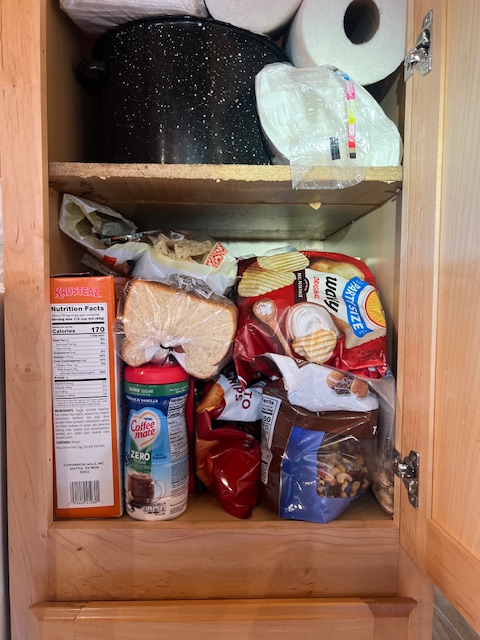
On one particular trip this summer, the kitchen cupboards were already so full that my sister-in-law unloaded her food supplies into a bedroom closet. It was a practical solution, but it left us with another question: Where were we supposed to put the clothes that actually belonged in the bedroom?
It seems unwanted food is left in the cupboards to age and multiply, while items you were actually planning to use have a considerably shorter life expectancy.
We learned that with charcoal.
Knowing we would be returning, we left three bags behind rather than hauling them home. When we came back, all three were gone.
Well, technically not. Two bags were gone, and the third contained a small handful of briquettes. No one mentioned using them, and no one warned us that we needed to bring more.
The charcoal was frustrating, but we could work around it. The discovery in the liquor cabinet felt a little more personal.
If you’ve never traveled to Canada, you might not realize that spirits are considerably more expensive there than we are accustomed to paying. To avoid that unnecessary expense, we plan ahead and bring the allowable amount across the border. Friends traveling with us also contribute a bottle or a case of beer to the shared supply. Whether everyone drinks it or not, it gradually creates a selection for evening cocktails on future visits.
After one trip, we had left a substantial supply behind—not only what we hadn’t finished, but several bottles our friends had brought and left. We were well stocked.
Usually, we kept our “stock” in a sealed tote, but because we were returning in a few short weeks—and because there was so much of it—we left it in the liquor cabinet. After all, we’re family. If someone ran short and needed a drink or two, we wouldn’t mind sharing. There was plenty.
At least, we didn’t think we would mind.
When we returned, we went against our better judgment and didn’t bring any alcohol with us. We already had more than enough waiting for us at Awanabatch.
At least, that was how we had left it.
After a long day of travel, loads of food, clothing and supplies are hauled in, unpacked and stowed. Once that is finished, relaxation time officially begins. It’s time for cocktails down by the water.
On this particular trip, we reached that moment and discovered that someone else had apparently been relaxing on our behalf.
Whoever had worked their way through our supply had thoughtfully left a dribble in the bottom of nearly every bottle. Not enough to make a drink, but enough to avoid being named the person who emptied it.
We didn’t think we needed anyone’s permission to leave our own alcohol for our own return. Evidently, while no one wanted our leftover food, our leftover liquor was another matter entirely.
We could have driven to the liquor store and replaced it. We weren’t stranded in the wilderness. We were simply too cheap—and by then too irritated—to pay Canadian prices for alcohol we had already purchased once.
No one ever confessed to drinking it. Perhaps several people had each helped themselves to just a little and no one realized how much was disappearing. The same may have been true of the missing charcoal.
That is one of the mysteries of sharing a family cabin. The supplies no one seems to want multiply, while three bags of charcoal and a cabinet full of liquor can disappear without anyone knowing what happened.
Whoever helped themselves can continue to claim they didn’t finish anything.
Because technically, they didn’t drink/use it all.